

Yes — for most busy cafés, a puck screen is worth adding. It reduces shot-to-shot variability, cuts shower-screen cleaning frequency, and costs little enough that the ROI calculation is straightforward. The conditional: if your grinder already delivers precise, consistent distribution and your variability is low, the gains will be modest. What follows covers the mechanics, the evidence, the trade-offs, and a practical trial plan you can run next shift.
Table of Contents
- What does a puck screen actually do to water flow?
- What does the community evidence actually show?
- What are the real trade-offs before you commit?
- When should a café actually adopt a puck screen?
- What to look for when buying puck screens for a café
- Key Takeaways
- Screen filters in cafés: what the evidence actually tells you
- Useful sources
- Clarmuse magnetic privacy screens for MacBook users in cafés
- FAQ
What does a puck screen actually do to water flow?
A puck screen is a thin disc, typically 58.5mm or 58mm in diameter, placed directly on top of the tamped coffee puck before the portafilter locks into the group head. Most are made from stainless steel mesh or perforated steel; some use food-grade silicone or nylon composites. The screen sits between the puck surface and the shower screen above it.
The mechanics are straightforward. When the pump engages, water hits the screen first rather than the puck surface directly. The screen diffuses that initial water pressure across the full puck diameter before it contacts the coffee. This secondary diffusion layer supplements the shower screen’s own distribution, reducing the likelihood of a high-pressure jet boring a channel through the puck.
Operationally, cafés observe three effects:
- Cleaner shower screen: Fine coffee particles and oils collect on the screen rather than migrating up to the shower screen, per product-and-practice guidance from Barista Essentials.
What does the community evidence actually show?
Community evidence for puck screens is real but limited in rigor. Reddit threads on r/espresso and r/barista, Facebook specialty coffee groups, and YouTube extraction demos consistently report small improvements in extraction yield and shot-to-shot consistency. The reported extraction yield changes are modest, typically in the low single-digit percentage range, and vary considerably depending on grinder, basket geometry, and barista technique. No peer-reviewed study with a controlled sample has been published on puck screens specifically.
Community testers on r/espresso frequently note that puck screens show the clearest benefit when paired with grinders that produce uneven distribution — the screen compensates for what distribution technique alone cannot fix. On well-dialed, high-end grinders, the difference narrows.
The methodological limits matter. Most home and café tests involve small sample sizes (10–30 shots), inconsistent tamp pressure across trials, and no refractometer for TDS verification. Machine variance between sessions adds noise. YouTube demos with extraction cameras are visually compelling but rarely control for dose weight. Take community yield figures as directional signals, not benchmarks.
What are the real trade-offs before you commit?
Puck screens add a variable to every shot, and that variable is not always neutral.
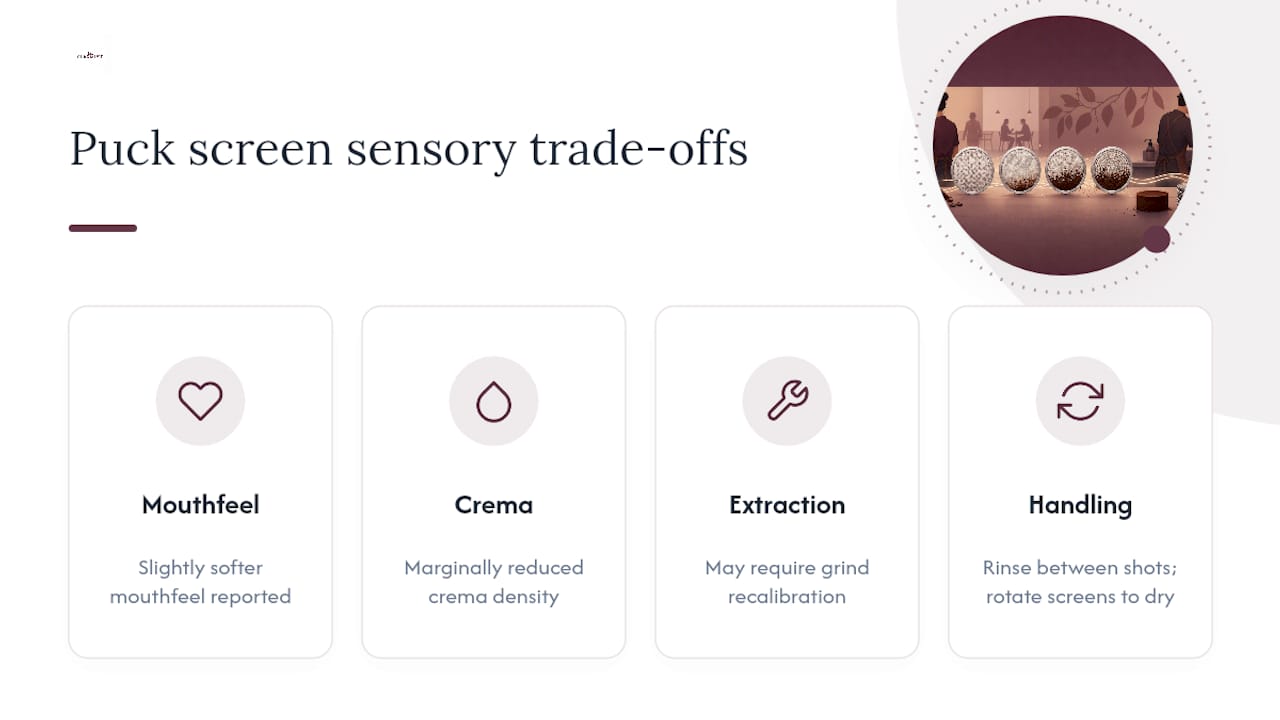
The most common operational issue is flow-time shift. The added resistance from the screen can extend pre-infusion and total shot time, sometimes by 3–8 seconds depending on screen mesh density and grind setting. If your current recipe is dialed to a specific yield-to-time ratio, you may need to adjust grind coarseness to compensate. That recalibration takes time and wastes shots during the adjustment period.
One experienced barista note from community forums: “The screen doesn’t fix a bad grind — it just makes a mediocre grind more forgiving. If you’re already pulling clean, consistent shots, you might not notice a difference worth the extra step.”
Cleaning and handling add friction. Each screen must be rinsed or wiped between shots in a high-volume setting, and a screen left too long between cleans can trap grounds that affect the next shot’s flavor. Screens also require a dedicated rotation inventory and a place to dry between uses.
Sensory changes are subtle and not universally preferred. Some baristas report a slightly softer mouthfeel and marginally reduced crema density with certain screen types. For specialty single-origin shots where texture is a primary quality marker, that shift may not align with the intended cup profile. Test before committing across all group heads.
When should a café actually adopt a puck screen?
Use this checklist to decide whether a trial makes sense for your operation.
Strong candidates for a trial:
- High-volume espresso bars (150+ shots per day) where shower-screen cleaning is a recurring labor cost
- Cafés with mid-range grinders where distribution consistency varies between baristas
- Training programs where reducing technique-dependent variability supports skill development
- Mobile or pop-up setups where equipment stability is variable
Scenarios where gains are likely modest:
- Operations already using precision dosing tools (e.g., distribution needles, levelers) with low shot-to-shot variability
- Specialty bars dialing for specific mouthfeel profiles where any sensory shift is undesirable
- Single-group setups pulling fewer than 50 shots per day, where cleaning time savings are minimal
Red flags: If your current extraction is already consistent and your shower screen stays clean between standard backflush cycles, a puck screen is unlikely to move the needle enough to justify the added workflow step.
What to look for when buying puck screens for a café
Not all screens perform the same way, and buying the wrong type wastes money and time.
Materials:
- Stainless steel mesh: Most durable, easiest to clean, and most widely used in commercial settings. Look for 200–300 micron mesh for a balance of diffusion and flow resistance.
- Perforated steel: More rigid, less prone to deformation, but offers less diffusion than mesh. Better for high-pressure machines.
- Silicone or nylon composite: Lighter and quieter in handling, but less durable under daily commercial use and harder to inspect for trapped grounds.
Buying checklist for café procurement:
- Confirm internal basket diameter before ordering (58mm vs. 58.5mm is a common mismatch)
- Check whether your baskets are recessed or raised-rim; some screens sit proud on recessed baskets and affect lock-in
- Order at minimum 6 screens per group head to support rotation and drying cycles
- Verify the screen is rated for commercial cleaning products (citric acid, Cafiza) without corrosion
- Check thickness: screens thicker than 0.5mm can affect headspace in tighter baskets
Cost per screen ranges from a few dollars for basic stainless options to $15–$25 for precision-machined versions. At commercial volumes, the cost-per-shift calculation is negligible against labor savings from reduced shower-screen cleaning.
Key Takeaways
Puck screens deliver the clearest ROI in high-volume cafés where shower-screen cleaning and shot consistency are daily operational concerns.
| Point | Details |
|---|---|
| Verdict for most cafés | Puck screens are worth trialing if you pull 100+ shots per day and want lower shower-screen cleaning frequency. |
| Strongest operational benefit | Reduced channeling and fewer mid-shift backflushes, not extraction yield, drive the real labor savings. |
| Flow-time adjustment | Added screen resistance can extend shot time; adjust grind one step coarser if flow time increases by more than 5 seconds. |
| Trial structure | Run a 3-week A/B test: one week baseline, one week with screens on one group head, one week of comparison. |
| Clarmuse for device protection | For laptop screen protection in beach-café environments, Clarmuse magnetic privacy screens offer model-specific fits for MacBook Air and Pro. |
Screen filters in cafés: what the evidence actually tells you
The puck-screen conversation in specialty coffee tends to split into two camps: enthusiasts who treat it as a near-mandatory upgrade and skeptics who dismiss it as marginal. Both positions miss the operational nuance.
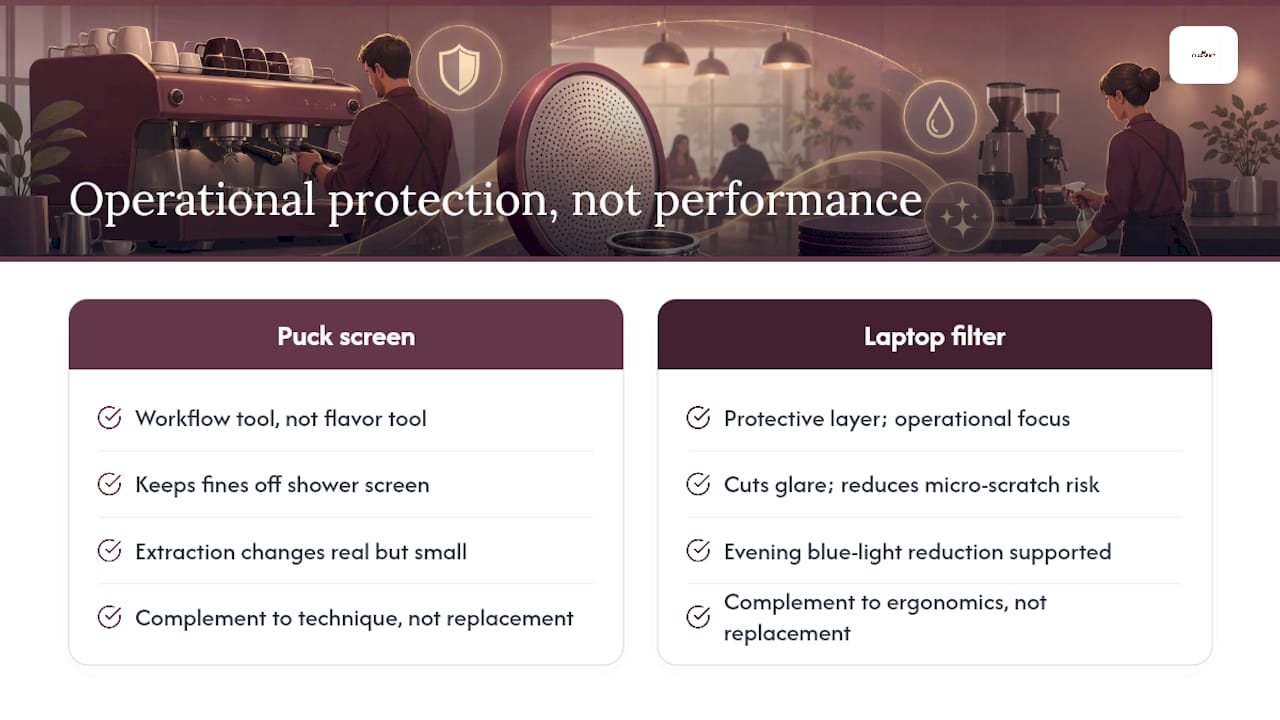
The honest read of the community evidence is that puck screens are a workflow tool, not a flavor tool. The extraction yield changes reported in forum threads and YouTube demos are real but small, and they depend heavily on the grinder and barista technique already in place. What is more consistent across reports is the cleaning benefit. A screen that keeps fines off the shower screen is doing something measurable and repeatable, regardless of whether TDS moves.
The parallel for laptop screens in beach-café environments is worth noting briefly. Digital nomad field guides document that coastal settings, with salt air, fine sand, and intense glare, are genuinely hostile to unprotected laptop screens. A matte or magnetic privacy filter acts as a sacrificial surface layer, reducing micro-scratch risk from sand and cutting glare without requiring higher brightness settings. Anti-glare matte filters improve readability in bright public workspaces and can indirectly reduce eye strain by allowing lower screen brightness. The ergophthalmology literature frames screen filters as a complement to ergonomic fundamentals, not a replacement for them. Harvard Health research supports evening blue-light reduction for sleep quality, though the evidence for daytime filtering is less definitive. Animal-model studies show selective short-wavelength filters can reduce markers of retinal stress under intensive exposure, though translation to normal device use is not direct. Hardware blue-light filters produce a permanent color shift; software modes like Night Shift offer reversible, scheduled reduction without hardware tint.
The common thread between espresso puck screens and laptop screen filters is the same: a thin, purpose-built layer between a sensitive surface and a hostile environment, chosen for operational reasons rather than theoretical ones. Whether you are protecting a puck from channeling or a MacBook screen from coastal abrasion, the decision framework is identical. Understand what the layer actually does, test it against your specific conditions, and measure the result.
Useful sources
Further reading on puck screens, screen filters, and device protection in café environments:
- LED-backlit tablet screen light on the structure, gene expression, and protein localization of the retina — MDPI
- Can blue-light blocking glasses improve your sleep? — Harvard Health Blog
- 4.4 Do We Need Filters in Computer Screens? | ergophthalmology.com
- Best Screen Filters for Eye Protection 2026: An Optometrist’s Guide — Desk Wellness Lab
- Blue Light Screen Protectors — Do They Actually Work? | Screen-Protectors.com
- Are Puck Screens Worth It? - Clive Coffee
- Puck screens: Everything you need to know about this barista tool
- Digital Nomads at the Beach · Where Is My Beach
Clarmuse product pages include light-transmission specifications and model-specific fit data for MacBook Air and MacBook Pro privacy screens, relevant to any café or coworking environment where device protection and screen readability matter.
Clarmuse magnetic privacy screens for MacBook users in cafés
Working at a beach café or any bright public space puts your MacBook screen under conditions it was not designed for: direct glare, fine particulate in the air, and side-angle visibility that exposes your screen to anyone nearby. Clarmuse magnetic privacy screens address all three without adding bulk or complexity to your setup.
Each screen attaches magnetically and removes in seconds, fits the exact dimensions of your MacBook model, and reduces side-angle visibility while cutting surface glare. The matte finish acts as a protective layer against fine sand and coastal abrasion. No adhesive, no residue, no permanent modification to your device.
Clarmuse makes model-specific screens for the MacBook Pro 16.2", MacBook Air 15.3", MacBook Pro 14.2", MacBook Neo 13.0", and MacBook Air 13.6" (M2, M3, M4, M5, 2022–2026). Browse the full MacBook Pro privacy screen collection to find your model and check fit specifications.
FAQ
Is a portafilter screen necessary for espresso?
No, but it is useful in specific conditions. A puck screen reduces channeling and shower-screen cleaning frequency, making it a practical addition for high-volume cafés or baristas working with inconsistent distribution.
What does a coffee filter screen do?
It sits on top of the tamped puck and diffuses incoming water pressure across the full puck surface before extraction begins, reducing the risk of channeling and keeping fines off the shower screen.
Are coffee puck screens worth it for a café?
For most cafés pulling 100+ shots per day, yes. The labor savings from reduced shower-screen cleaning and fewer off-shots during rush periods typically outweigh the cost of screens and the minor workflow addition, per Clive Coffee’s operational review.
What does a screen filter do for a laptop in a beach café?
A matte or magnetic privacy screen filter cuts glare, reduces side-angle visibility, and acts as a protective surface layer against fine sand and coastal abrasion. Clarmuse magnetic privacy screens are designed specifically for MacBook models and attach without adhesive.


